
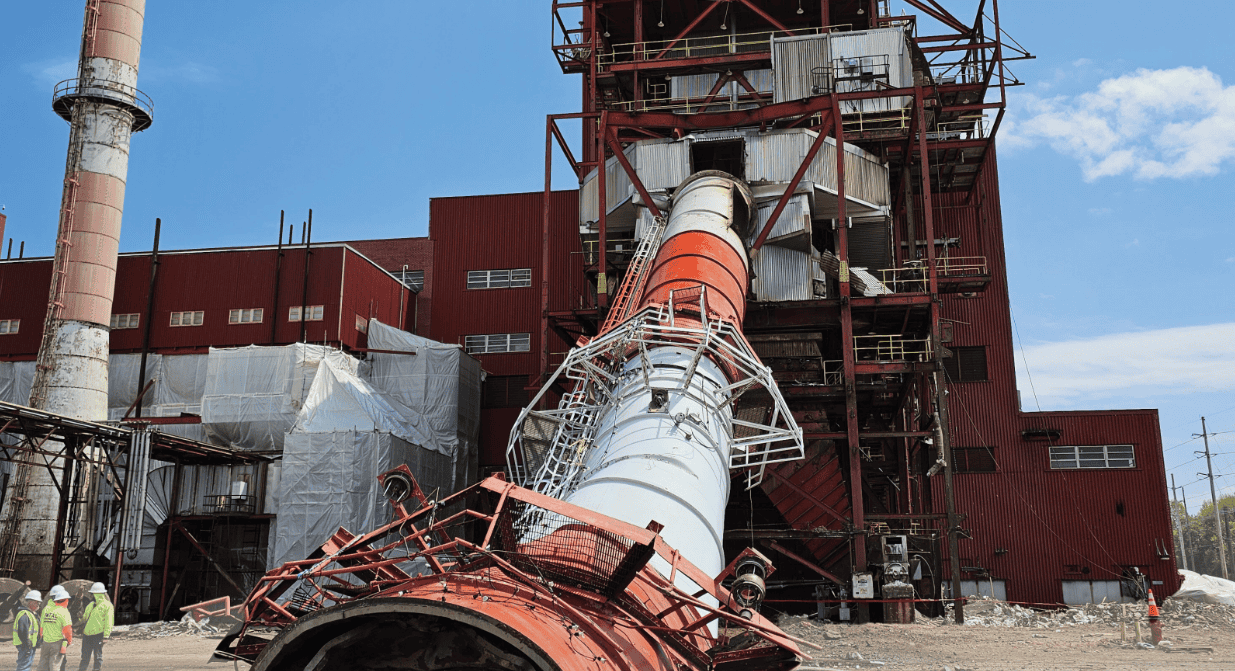
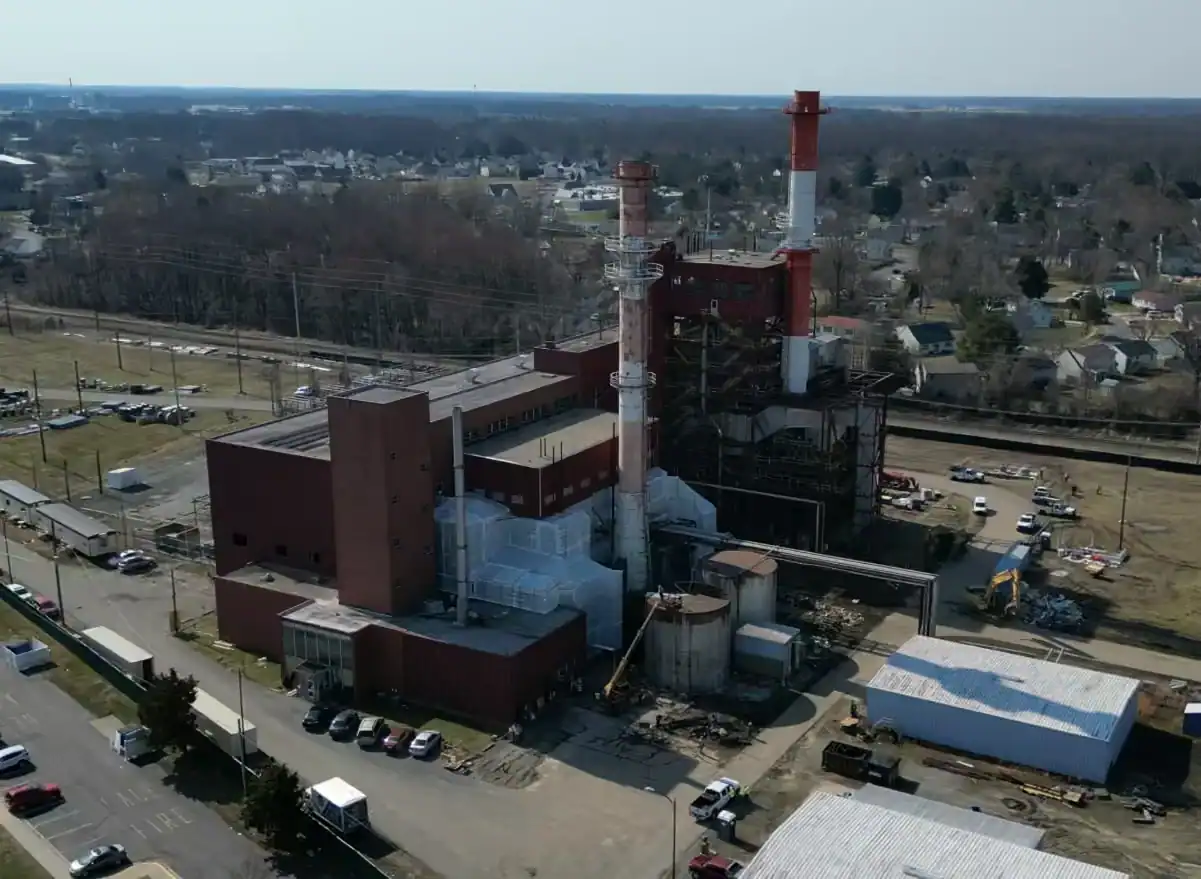
A retired Dover, Delaware power station, taken down in 9 months directly next to a neighborhood, and not one resident complaint.
Key Metrics
Key Takeaways
Project Overview
The McKee Run Generating Station ran on the Delaware grid from 1961 until the City of Dover took it offline for good in June 2021. With the plant idle, the city moved to clear the site for redevelopment and put the demolition out to competitive bid.
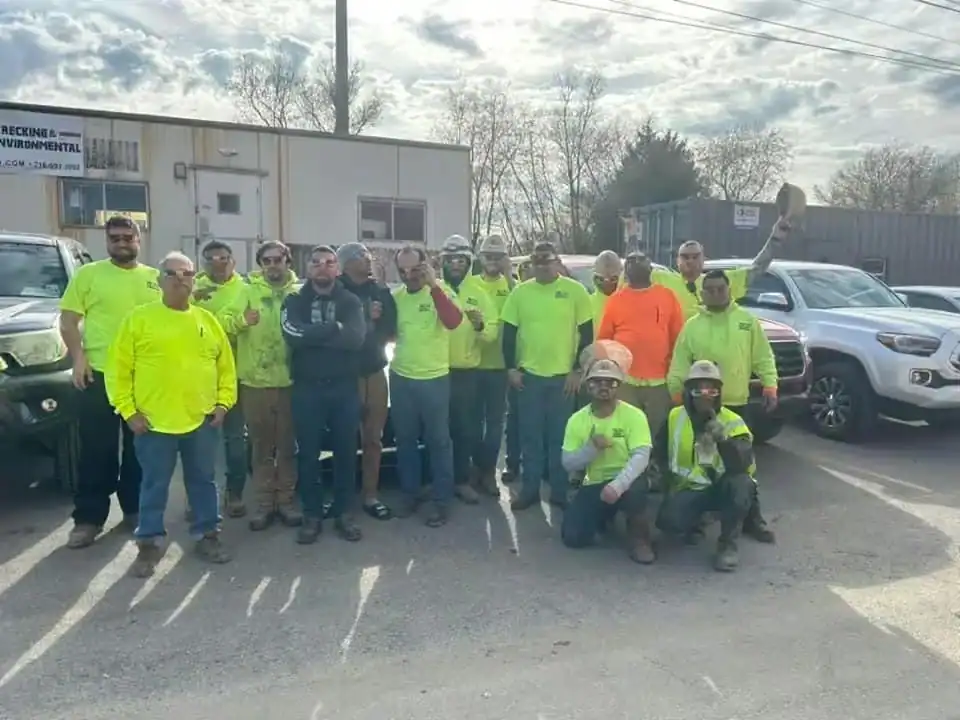
We started in January 2024 and removed the entire plant: a powerhouse holding boilers, turbines, generators, transformers and two stacks, plus two cooling towers on the north side of the site and the tanks and shops around them, all of it on a postage-stamp-sized site positioned against a residential street. The city projected 10 to 14 months. We closed out in October 2024, nine months in, with a 46-person crew, 95% of the material recycled, zero safety incidents across more than 36,000 work hours, and no complaints from the neighborhood.
Winning the Bid
Dover didn’t hand this contract to whoever came in cheapest. The city ran a full competitive bid that moved through bid submissions, a contractor shortlist, interviews, and public city council review before it named a winner.
What put us in front was the record and the plan. We came in with a history of large industrial jobs finished on schedule and without incident, and with a sequence built around the city’s own priority. Dover’s concern from the first conversation was what the neighborhood would have to live through, so we planned the job around that constraint rather than around the fastest route to the ground.
Asset Recovery
Recovery comes before demolition, the way it does on every job. Crews worked the accessible areas first, pulling copper wiring for recycling and cutting the turbine shells open with six-foot torches to free the shafts, which were rigged and lowered whole for resale. Structural steel and scrap metal went out for processing and reuse. By closeout about 95% of everything on the site had been recycled or resold, and the cooling towers were the only exception. Their pressure-treated wood carried arsenic and chromium, so they were hauled off as construction and demolition waste.
The Plant and the Neighborhood
McKee Run opened in 1961 with two Westinghouse units at 16.5 MW apiece, both burning coal. By 1972 the plant had converted to fuel oil and natural gas, and that same year Dover added Unit 3, a 102 MW GE steam turbine on a Riley Stoker boiler rated for gas or No. 6 fuel oil. A 2008 conversion moved all three units to No. 2 fuel oil and gas. Units 1 and 2 came offline in 2017, and the plant shut down for good four years later.
Six decades of operation leave a building full of material that can’t go to a landfill. Asbestos turned up in the building materials and in the cooling tower siding, and more of it was wrapped around the metal piping. Old wiring ran through the walls, and the equipment still held transformer oils, mercury switches and universal waste. All of it had to be removed, segregated and disposed of properly before heavy demolition could start.
The harder constraint was the footprint. The plant sat directly against a residential street, and the working area was tight enough that the boiler and the two stacks had to come down to the inch. There’s no room for a wide drop zone when the nearest back yard is on the other side of the fence.
Taking It Down
Nothing came down until the site was secure. Utilities were disconnected, dust control went up, and permitting and compliance were squared away with the city. Because the site directly bordered a residential neighborhood, we explicitly designed and executed every phase of site preparation to suppress dust and noise so that every nearby home had complete protection throughout the project.
Abatement was next. Twenty-three crew members pulled the asbestos, universal waste, transformer oils, mercury switches and old wiring, and disposed of it to code. Demolition worked behind them area by area, moving into each section as it was cleared instead of waiting for the whole building.
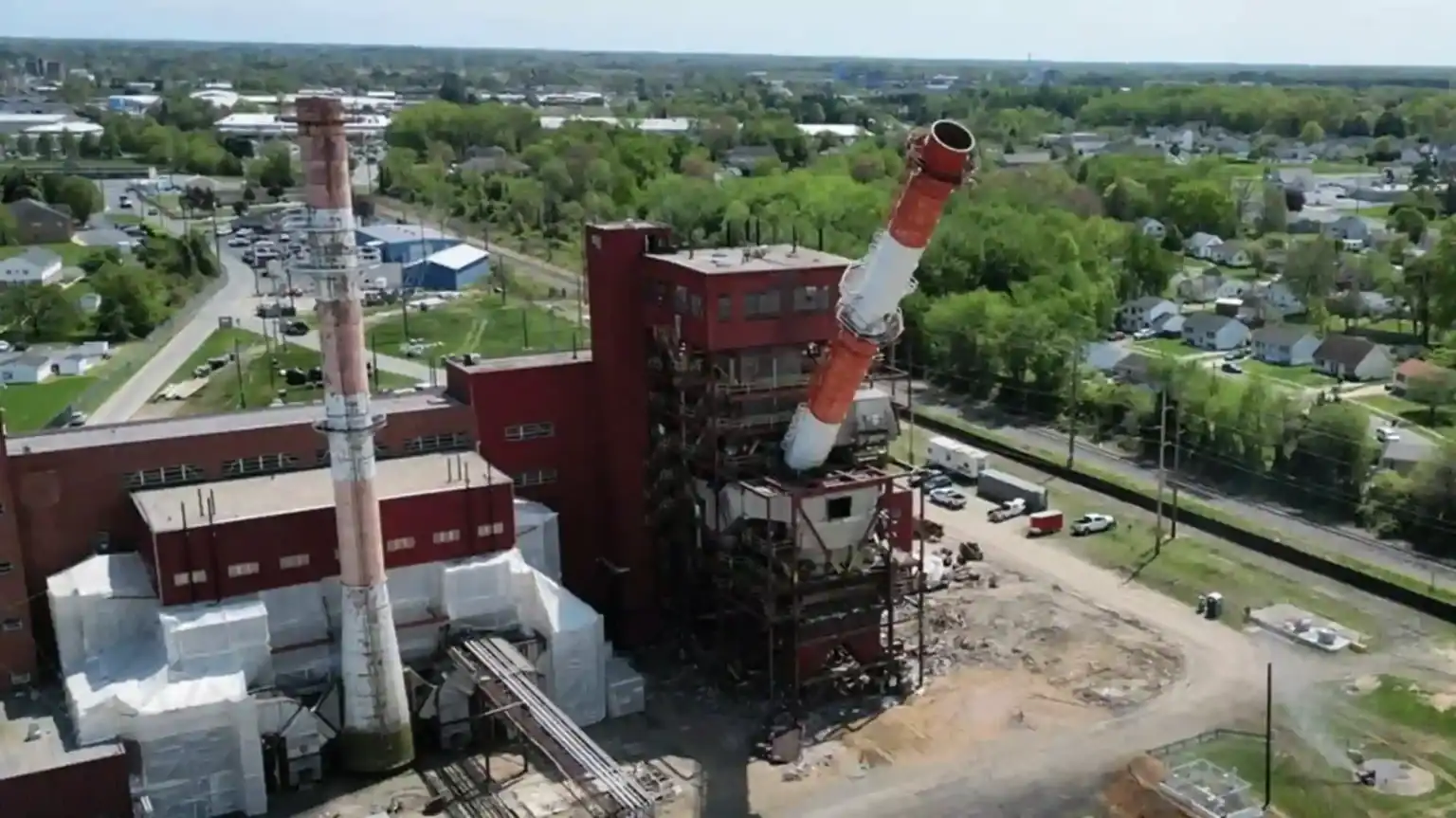
The cooling towers came down first, at 155 by 53 feet and 180 by 54 feet. Neither could be dropped. They were built from pressure-treated wood on concrete bases with fiberglass and plastic trays inside, so they were dismantled piece by piece. The powerhouse was the core of the plant, and we worked through it section by section with a 110-foot high-reach excavator running a shear, then brought the two stacks down with a controlled pull.
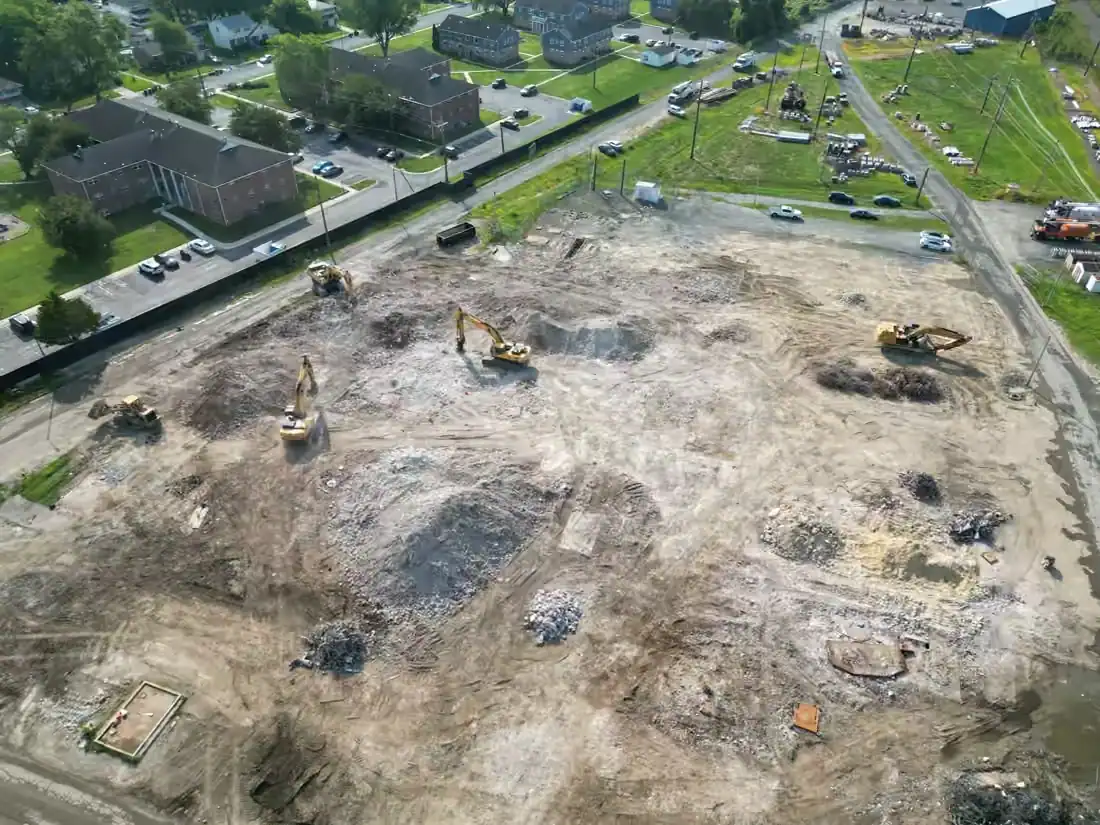
The iron on site ran heavy. The 100,000-pound excavators carried demolition shears, grapples, concrete processors and hydraulic hammers, and a 950 front loader and a 10,000-pound telehandler moved material to the stockpiles for resale or scrap. Once the structures were down, the abandoned circular water lines under the site were flow-filled so the ground wouldn’t shift later, and the lot was backfilled and graded before we handed the site back over.
The Result
We closed out in October 2024, nine months after starting and well inside the city’s own estimate. We achieved this by planning the sequence before anyone touched a beam and by staffing the project with crews who have dismantled plants like this one for years.
The team was exceptionally proud to achieve a 95% recycling rate on a facility of this era, which required the utmost sorting discipline and a crew that stayed committed to consistency day after day.
Forty-six crew members put in more than 36,000 work hours with zero safety incidents and no reportable injuries. Demolition is inherently dangerous work, and one bad call on a site this tight puts somebody in danger, so every crew ran the same protocols from the first day to the last.
And not a single complaint. Not one, across nine months, from any neighbor a stone’s throw away from the jobsite. Given the proximity and sensitivity, that’s one of the numbers we’re proudest of.
What the Client Said
Paul Waddell, Electric Director for the City of Dover, put it in writing when the job closed.
“Given the location of the McKee Run Generation Station, which is near a residential community, we recognized that potential impacts to the neighborhood could have occurred. Total Wrecking took the initiative to participate in a community meeting to personally address concerns and provide detailed explanations about the project’s timeline and processes. Their transparency and willingness to engage with the community were instrumental in keeping public concerns at bay. We received zero complaints over the life of the project.”
“Their expertise, attention to detail, and commitment to safety and budget efficiency made them an invaluable partner in the successful decommissioning of the McKee Run Generation Station.”
Paul Waddell
Electric Director, City of Dover Electric
McKee Run is the kind of job Total Wrecking is built for: a plant that has reached its end of life in a community that is ready for redevelopment and that has to come down where you can’t afford to disturb the people living around it. Power plants, refineries and mills are unique beasts that require totally different processes.
If that’s your site, tell us about it and we’ll walk you through how we’d approach it.